
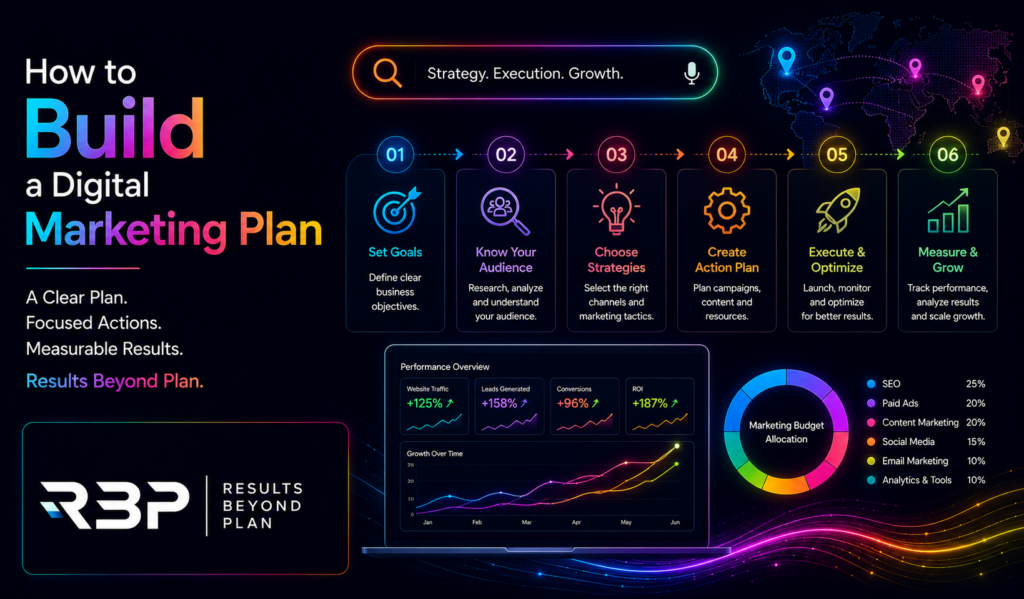
Most Canadian businesses understand that digital marketing matters. Fewer have a clear, structured plan behind their digital activities. Without a plan, marketing becomes reactive – responding to trends, copying competitors, and spending budget without a clear sense of what is working or why.
A Digital Marketing Plan (DMP) changes that. It gives your business a strategic foundation, clear priorities, and a measurable roadmap for digital growth. This guide will walk you through how to build one from scratch – practical, actionable, and tailored to the Canadian market.
What Is a Digital Marketing Plan?
A Digital Marketing Plan is a structured document that defines your marketing goals, your target audience, your chosen channels, your content strategy, your budget allocation, and your measurement framework. It is the strategic blueprint that connects your business objectives to your digital marketing activities.
A DMP is not a rigid document that never changes. It is a living plan that you review and update regularly – typically quarterly – based on performance data and shifting business priorities.
For Canadian businesses, a well-built DMP also accounts for the specific characteristics of the Canadian market – regional differences, bilingual considerations where relevant, Canadian search behavior, and the competitive landscape in your specific industry and geography.
Why Most Canadian Businesses Market Without a Plan – and Why That Is a Problem
The most common pattern we see with Canadian businesses is a collection of disconnected marketing activities – a social media account that gets updated occasionally, a website that has not been touched in two years, some Google Ads that were set up and forgotten, and a blog that was started with good intentions but abandoned after three posts.
This approach produces unpredictable results, wastes budget, and makes it impossible to understand what is actually driving business growth.
A digital marketing plan solves this by:
- Giving every marketing activity a clear strategic purpose
- Ensuring your budget is allocated to the highest-impact channels
- Creating accountability through measurable goals and regular reporting
- Building consistency – the single most important factor in digital marketing success
- Allowing you to make informed decisions based on data rather than instinct
Step 1 – Define Your Business Goals and Marketing Objectives
Every effective Digital Marketing Plan starts with clarity about what the business is trying to achieve. Your marketing objectives must connect directly to your business goals – otherwise your marketing activities have no meaningful purpose.
Common business goals for Canadian companies:
- Increase revenue by a specific percentage
- Enter a new Canadian market or region
- Grow the customer base in a specific industry
- Launch a new product or service
- Improve customer retention and repeat business
Translating business goals into marketing objectives:
For each business goal, define a specific, measurable marketing objective. For example:
- Business goal: Grow revenue by 20% in the next 12 months
- Marketing objective: Increase qualified website leads by 40% through organic search and content marketing
Be specific. Vague objectives like “increase brand awareness” are difficult to measure and even harder to act on. Define your objectives with numbers, timelines, and clear definitions of success.
Step 2 – Know Your Target Audience
Effective digital marketing is built on a deep understanding of who you are trying to reach. In Canada, this means understanding not just your ideal customer’s demographics but their specific behaviors, needs, and decision-making processes in the Canadian context.
Build audience personas for your business:
An audience persona is a detailed profile of your ideal customer. It should include:
- Demographics: age, location, industry, job title, income level
- Goals and motivations: what are they trying to achieve?
- Pain points and challenges: what problems are they trying to solve?
- Search behavior: what terms and phrases do they use when searching online?
- Decision-making process: how do they research and evaluate options before buying?
- Geographic specifics: which Canadian cities, provinces, or regions are most relevant?
Most businesses have two to four distinct audience personas. Building clear personas allows you to create content and messaging that speaks directly to each audience – rather than producing generic content that resonates with no one.
Step 3 – Audit Your Current Digital Presence
Before building a plan for where you want to go, you need an honest assessment of where you are today. A digital marketing audit gives you a clear baseline to measure progress against and identifies the most urgent gaps to address.
Your audit should cover:
Website performance
- How much organic traffic is your website receiving?
- Which pages are performing well and which are underperforming?
- Is your website technically sound – fast, mobile-friendly, and properly indexed by Google?
- Are your pages optimized for the keywords your target audience is searching for?
Search visibility
- Which keywords is your website currently ranking for in Canada?
- How does your search visibility compare to your main competitors?
- Are you showing up in local and regional searches relevant to your business?
Content assessment
- What content does your website currently have?
- Is it accurate, relevant, and optimized for search?
- What content gaps exist relative to what your audience is searching for?
Social media presence
- Which platforms are you on?
- Are you posting consistently?
- What engagement are your posts generating?
Analytics and tracking
- Is Google Analytics properly installed and configured?
- Is Google Search Console set up and connected?
- Are you tracking conversions and leads from your website?
The audit findings directly inform your plan – telling you where to focus first and which gaps to prioritize.
Step 4 – Choose Your Digital Marketing Channels
One of the most important decisions in building your Digital Marketing Plan is choosing which channels to focus on. The most common mistake Canadian businesses make is trying to be everywhere at once – spreading resources too thin and producing mediocre results across too many channels.
A focused strategy that executes well on two or three channels will consistently outperform a scattered approach across six or seven.
The core digital marketing channels for Canadian businesses:
Search Engine Optimization (SEO)
SEO is the foundation of long-term digital growth. It builds organic search visibility that compounds over time and delivers high-intent traffic without ongoing ad spend. For most Canadian businesses, SEO should be the primary digital marketing investment.
Content Marketing
Content and SEO work together. A consistent content strategy – publishing helpful, relevant articles and resources – builds search visibility, establishes authority, and creates value for your audience at every stage of the buying journey.
Local and Geographic SEO
For businesses serving specific Canadian markets, local and geographic SEO is essential. Optimizing your Google Business Profile and building local search visibility drives foot traffic, phone calls, and local leads.
Email Marketing
Email delivers one of the highest returns on investment of any digital marketing channel. A well-managed email list allows you to communicate directly with your audience, nurture leads, and retain existing customers at minimal cost.
Social Media Marketing
Social media supports brand building, community engagement, and content distribution. For most B2B and professional services businesses in Canada, LinkedIn and organic content strategies deliver better results than paid social advertising.
Paid Search (Google Ads)
Paid search can accelerate results while organic SEO builds over time. It is most effective when used strategically – targeting high-intent keywords with well-optimized landing pages – rather than as a substitute for organic visibility.
Step 5 – Build Your Content Strategy
Content is the engine behind SEO, lead generation, and audience trust. Your content strategy defines what you will publish, where you will publish it, how often, and for whom.
Content strategy framework:
Content pillars
Define three to five core topics that align with your expertise, your audience’s needs, and your target keywords. Every piece of content you create should connect to one of these pillars.
Content types
Decide which content formats you will produce – blog articles, guides, case studies, videos, infographics, email newsletters. Start with one or two formats you can execute consistently and expand over time.
Publishing frequency
Consistency matters more than volume. A realistic publishing schedule you can maintain – one well-researched blog post per week, for example – is more effective than an ambitious schedule you cannot sustain.
Content calendar
Plan your content at least one month in advance. A content calendar ensures you stay consistent, allows you to align content with seasonal trends and Canadian events, and prevents the last-minute scramble that produces low-quality content.
Step 6 – Set Your Budget
Budget allocation is one of the most important – and most often avoided – elements of a digital marketing plan. Canadian businesses frequently underinvest in digital marketing and then wonder why results are slow.
General budget guidance for Canadian small and medium businesses:
There is no universal rule for digital marketing budget, but a widely used benchmark is allocating 7 to 10 percent of revenue to marketing for growth-focused businesses – with the majority of that allocated to digital channels.
Prioritizing your budget:
Allocate budget in order of expected return:
- SEO and content marketing – highest long-term return
- Local SEO and Google Business Profile – high return for location-based businesses
- Email marketing – low cost, high return for existing customer base
- Paid search – effective for immediate lead generation while organic builds
- Social media – supporting role, lower budget allocation unless social is a primary channel for your industry
Step 7 – Define Your KPIs and Measurement Framework
A Digital Marketing Plan without measurement is incomplete. Define the specific Key Performance Indicators (KPIs) you will track to measure progress toward each of your marketing objectives.
Core KPIs for Canadian businesses:
- Organic website traffic (monthly, year over year)
- Keyword rankings for target search terms in Canada
- Lead volume from organic search
- Google Business Profile views and actions
- Email list growth and open rates
- Conversion rate from website visitors to leads
- Customer acquisition cost by channel
- Return on marketing investment
Set up a monthly reporting process. Review your KPIs at the end of each month and use the data to make informed decisions about what to continue, what to improve, and what to stop.
Step 8 – Review and Update Your Plan Quarterly
Digital marketing is not static. Search algorithms change, competitive landscapes shift, and new opportunities emerge. Your Digital Marketing Plan should be reviewed and updated at least once per quarter.
A quarterly review should assess:
- Performance against your KPIs
- What is working and should be scaled
- What is underperforming and needs to be adjusted or replaced
- Any new opportunities in your market or channels
- Budget reallocation based on performance data
The businesses that get the best long-term results from digital marketing are the ones that treat their DMP as a living document – continuously improving based on real data.
Building a Digital Marketing Plan Takes Time – But It Is Worth It
Putting together a complete Digital Marketing Plan requires research, strategic thinking, and honest assessment of your current situation. Most Canadian business owners do not have the time or the specialized knowledge to build one effectively on their own.
That is where working with a digital marketing partner pays dividends. A well-built DMP saves you from wasting budget on the wrong channels, gives your team a clear direction, and creates a foundation for consistent, measurable growth.
At RBP Digital Marketing, building Digital Marketing Plans for Canadian businesses is one of our core services. We handle the research, the strategy, and the documentation – and then help you execute it.
Book a free consultation to discuss your Digital Marketing Plan at Boustan.co/contact
RBP Digital Marketing is a Canadian digital marketing and IT consultancy specializing in SEO, digital strategy, and healthcare marketing. Based in Canada, serving businesses across the country.